So... I finished these stays back in february in good time for the HSM challenge, got some decent photos and then promptly forgot about the blogging part. I thought about blogging them this summer after their first official outing, but that obviously didn't happen. Then my historical sewing "club" started talking about stays, and I remembered to write this post.
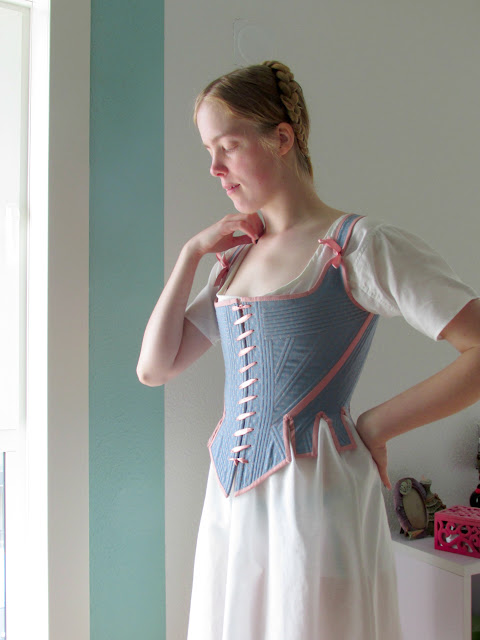
Long story short, let me show you my finished stays:

I love them. They give me the fashionable 18th century shape while still being deceptively comfortable and undeniably cute to look at.


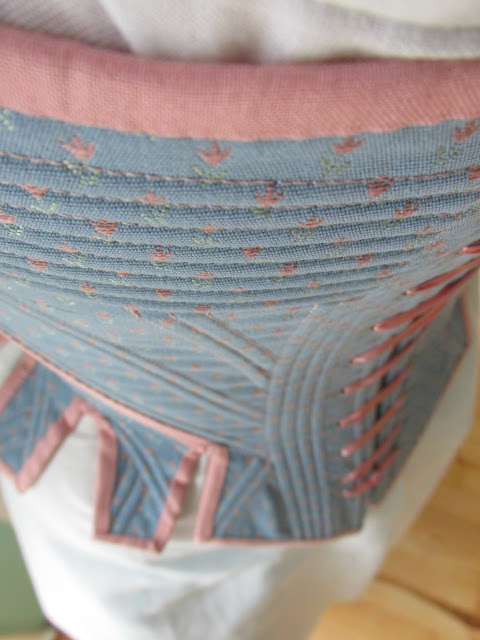
The outer fabric is a heavy cotton upholstery brocade I found as a remnant at Videbæk Stof-Sycenter (my favorite fabric shop). It is a beautiful periwinkle blue with small tulip-like flowers in dusty pink and pale green woven into it (see picture below). It is still available at Historicum for anyone interested. I used about a half meter. This particular length was bought for me by my boyfriend as part of a swap.

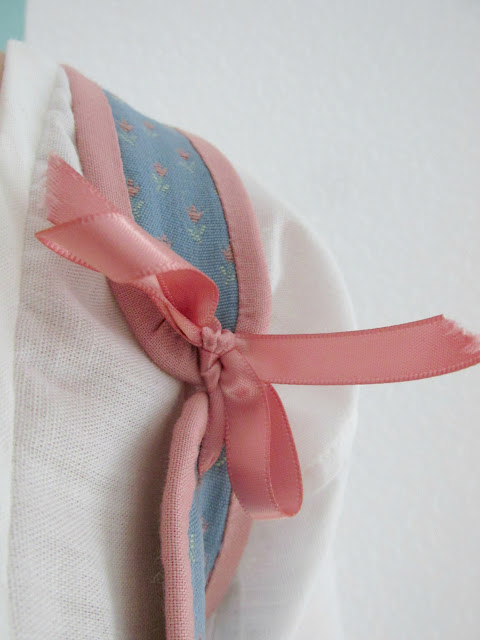
It is interlined in a heavy tan linen/viscose blend from my stash. I made the coordinating pink binding with half a meter of cotton broadcloth from Stof&Stil in the color "antique rose". I used 25 mm binding for covering the inside seam allowances in lieu of a separate lining, the 18 mm for binding the edges and the 12 mm for decorating/highlighting the seam lines on the outside.

The pattern is Butterick 4254 view B. I had to make a few modifications, mainly due to the weird big-4 sizing and the pattern being very short-waisted. I had the size 12-14-16 packet, but the recommended size (14) was WAY to big for me. The 12 was a little better, but not ideal. I ended up taking it in a couple of cm at each center back edge, lower the back neckline, moved the front strap toward center front, adding height to the front neckline and narrowing the straps.
I also changed the boning layout a bit to allow me to do spiral lacing.

The boning is made up of 98 separate pieces of zip-ties, all cut and filed down by hand with a nail file. Each zip-tie was only 0,5 cm wide, so I put 2 ties in every boning channel marked on the pattern. Only the channels and main seam are sewn by machine, as all binding, lacing holes and finishing is done by hand. I LOVE my thimble!

Needless to say, these stays were a labor of love, and OMG I love them! They are so "me", and ohh so nice to wear. In fact, I wore them for 3 full days at the 18th century fair in June, and loved every minute of it. Never will I ever have cut marks on my waist from wearing 3+ heavy skirts all day again!
As this is my official entry for the HSM, here are the specs:
The Challenge: Blue (February 2015)
Item: Half-boned mid-to-late 18th century stays
Long story short, let me show you my finished stays:

I love them. They give me the fashionable 18th century shape while still being deceptively comfortable and undeniably cute to look at.


The outer fabric is a heavy cotton upholstery brocade I found as a remnant at Videbæk Stof-Sycenter (my favorite fabric shop). It is a beautiful periwinkle blue with small tulip-like flowers in dusty pink and pale green woven into it (see picture below). It is still available at Historicum for anyone interested. I used about a half meter. This particular length was bought for me by my boyfriend as part of a swap.

It is interlined in a heavy tan linen/viscose blend from my stash. I made the coordinating pink binding with half a meter of cotton broadcloth from Stof&Stil in the color "antique rose". I used 25 mm binding for covering the inside seam allowances in lieu of a separate lining, the 18 mm for binding the edges and the 12 mm for decorating/highlighting the seam lines on the outside.

The pattern is Butterick 4254 view B. I had to make a few modifications, mainly due to the weird big-4 sizing and the pattern being very short-waisted. I had the size 12-14-16 packet, but the recommended size (14) was WAY to big for me. The 12 was a little better, but not ideal. I ended up taking it in a couple of cm at each center back edge, lower the back neckline, moved the front strap toward center front, adding height to the front neckline and narrowing the straps.
I also changed the boning layout a bit to allow me to do spiral lacing.

The boning is made up of 98 separate pieces of zip-ties, all cut and filed down by hand with a nail file. Each zip-tie was only 0,5 cm wide, so I put 2 ties in every boning channel marked on the pattern. Only the channels and main seam are sewn by machine, as all binding, lacing holes and finishing is done by hand. I LOVE my thimble!

Needless to say, these stays were a labor of love, and OMG I love them! They are so "me", and ohh so nice to wear. In fact, I wore them for 3 full days at the 18th century fair in June, and loved every minute of it. Never will I ever have cut marks on my waist from wearing 3+ heavy skirts all day again!
As this is my official entry for the HSM, here are the specs:
The Challenge: Blue (February 2015)
Item: Half-boned mid-to-late 18th century stays
Fabric: Blue cotton upholstery brocade with woven flower motif for the outer layer. Heavy tan linen/viscose for interlining. Dusty pink cotton broadcloth for coordinating binding.
Pattern: Butterick 4254 view B, size 12, modified for fit
Year: 1750-1780-ish
Notions: 98 pieces of "plastic whalebone" (aka zip ties), coordinating pink 12 mm, 18 mm & 25 mm single fold cotton non-bias binding tape and coordinating pink poly satin ribbon.
How historically accurate is it? 50-80 %? The pattern pieces and boning layout looks decent compared to historical garments, despite being laced both in the front and back. The zip ties are also a good approximation to whalebone, and the spiral lacing is spot on!
Hours to complete: Mockup: 2 hours. Machine sewing: 4 hours. Hand sewing, hardware & finishing: 20-40 hours?
First worn: For pictures and singing practice at home and at the Oceanos festival in Frederikshavn, DK in June 2015.
Total cost:
- Blue fabric: a swap with my boyfriend ~ free!
- pink fabric for contrast: 10 dkk
- pink thread: 16 dkk
- zip ties ~ 10 dkk
- pink ribbon: 30 dkk
- Linen lining: from stash ~ free!
Total ~ 66 dkk or just under 10 USD
Final thoughts:
Did I mention that I love them? I do. I really, really do. The colors, the fit, everything!
- Blue fabric: a swap with my boyfriend ~ free!
- pink fabric for contrast: 10 dkk
- pink thread: 16 dkk
- zip ties ~ 10 dkk
- pink ribbon: 30 dkk
- Linen lining: from stash ~ free!
Total ~ 66 dkk or just under 10 USD
Final thoughts:
Did I mention that I love them? I do. I really, really do. The colors, the fit, everything!